There are few things more disappointing than preparing breakfast, opening a fresh package of bacon, and suddenly spotting something that doesn’t look quite right.
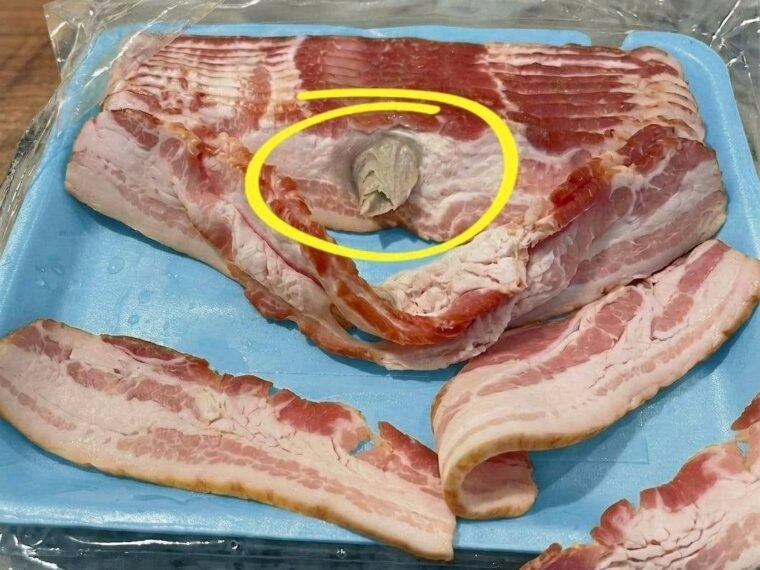
Maybe it’s a pale lump hidden between the strips.
Maybe it’s a strange bean-shaped mass embedded in the fat.
Maybe it’s a firm, rubbery piece that looks completely different from the rest of the meat.
You freeze.
Your appetite disappears instantly.
Questions begin racing through your mind.
What is that?
Is it a parasite?
Is it a tumor?
Did the meat go bad?
Should I throw away the entire package?
For many people, this discovery triggers immediate disgust. Some throw the bacon straight into the trash without a second thought. Others spend hours searching for answers, convinced they may have stumbled upon something dangerous.
The truth, however, is usually far less dramatic than the imagination suggests.
That mysterious lump found in bacon is often one of the most misunderstood aspects of meat processing. While it may look alarming, in most cases it represents a completely natural part of the animal’s anatomy rather than contamination, disease, or a manufacturing mistake.
Understanding what you’re actually seeing can save money, reduce food waste, ease unnecessary anxiety, and help you make informed decisions about food safety.
Before you throw away an entire package of bacon because of one unusual-looking spot, it helps to understand how bacon is made, why these structures appear, what they really are, and when a strange lump is actually cause for concern.
The answer may surprise you.
Why Finding a Strange Lump Feels So Alarming
Humans are naturally cautious about food.
This survival instinct has protected people for thousands of years.
When food looks unusual, our brains immediately become suspicious.
We ask questions such as:
- Is it safe?
- Is it spoiled?
- Could it make me sick?
- Does it indicate disease?
- Should I throw it away?
This reaction is completely normal.
Food safety is deeply connected to survival instincts, which is why unexpected appearances can trigger such strong emotional responses.
The problem is that modern consumers often see only the finished product.
Most people never witness:
- livestock anatomy
- meat processing
- butchering techniques
- natural tissue structures
As a result, anything that looks unfamiliar immediately seems wrong.
Understanding Where Bacon Comes From
To understand strange lumps in bacon, you first need to understand bacon itself.
Bacon comes primarily from pork belly.
The pork belly is not a uniform piece of meat.
Instead, it contains a complex mixture of:
- muscle
- fat
- connective tissue
- blood vessels
- nerves
- lymphatic tissue
When a pig is alive, all of these structures serve important biological functions.
After processing, however, some of these natural structures occasionally remain visible within bacon slices.
This surprises consumers because supermarket meat is often expected to look perfectly uniform.
Nature rarely produces perfect uniformity.
Why Bacon Shows Strange Structures More Than Other Meats
Many people wonder:
“Why do I never see this in chicken or steak?”
The answer lies largely in how bacon is prepared.
Bacon Is Sliced Very Thin
Thin slicing reveals internal structures more clearly.
A small tissue deposit that would remain invisible inside a thick pork roast becomes highly visible when sliced into thin strips.
Bacon Contains More Fat
Pork belly naturally contains large amounts of fat.
Fat surrounds many anatomical structures that become noticeable after slicing.
These structures may include:
- lymph nodes
- fat deposits
- connective tissue
Bacon Is Not Ground
Ground meat blends everything together.
Bacon remains intact.
Natural structures therefore stay visible.
The Most Common Explanation: Fat Deposits
In many cases, the strange lump turns out to be nothing more than a concentrated fat deposit.
Fat does not distribute itself perfectly evenly throughout the pork belly.
Sometimes it accumulates in denser areas.
These deposits often appear:
- pale white
- cream-colored
- yellowish
- smooth
- waxy
- rubbery
Because they differ dramatically from surrounding meat, they immediately attract attention.
Yet they are often completely harmless.
Why Fat Deposits Look So Strange
Most consumers expect bacon fat to appear in thin streaks.
When fat accumulates in larger concentrations, it looks different.
The texture becomes:
- firmer
- denser
- more solid
Instead of blending naturally into the strip, it forms a noticeable lump.
This appearance can create the illusion that something is wrong when, biologically speaking, nothing unusual is happening.
The Lymph Node Explanation
Another common source of concern is the lymph node.
This is the explanation that surprises many people the most.
Animals possess lymph nodes just as humans do.
These structures form part of the immune system.
Their job is to:
- filter fluids
- trap pathogens
- support immune responses
Lymph nodes are normal anatomical structures found throughout the body.
Sometimes small portions remain within processed meat products.
What a Lymph Node Looks Like
A lymph node may appear:
- oval-shaped
- bean-shaped
- pale
- firm
- slightly darker in the center
Many consumers mistake these structures for:
- tumors
- parasites
- contamination
In reality, they are often simply normal tissue.
The appearance may be unpleasant, but appearance alone does not indicate danger.
Why People Mistake Lymph Nodes for Parasites
Parasites create strong emotional reactions.
The moment people see an unfamiliar lump, many immediately assume the worst.
However, visible lumps in bacon rarely represent parasites.
Modern pork production has dramatically reduced parasite risks through:
- veterinary monitoring
- controlled feeding practices
- food safety regulations
- inspection procedures
Most parasites associated with pork are microscopic rather than large visible masses.
The large pale lump people often discover is typically something entirely different.
Scar Tissue: Another Possibility
Animals live active lives.
Like humans, they experience:
- minor injuries
- bumps
- scrapes
- bruises
As tissues heal, scar formation can occur.
Scar tissue differs from normal muscle and fat.
It may appear:
- darker
- denser
- firmer
- irregularly shaped
This can create unusual appearances that consumers find alarming.
Yet healed scar tissue is generally not dangerous.
Why Natural Anatomy Looks Strange in Food
One reason consumers react strongly is because modern food presentation often disconnects people from the realities of animal anatomy.
Many people grow up seeing meat only after:
- trimming
- packaging
- processing
As a result, consumers develop expectations that meat should appear perfectly consistent.
But animals are biological organisms, not manufactured products.
Natural variation is inevitable.
The Psychology of Food Fear
Food-related fear follows predictable psychological patterns.
The brain rapidly asks:
- Is this normal?
- Is this dangerous?
- Could I become sick?
Uncertainty amplifies anxiety.
This explains why strange food discoveries feel so emotionally powerful.
The fear often stems less from actual danger and more from not knowing what we are looking at.
Knowledge reduces anxiety.
When You Actually Should Worry
While many lumps are harmless, certain warning signs deserve attention.
Unusual Colors
Discard the product if you observe:
- green discoloration
- black discoloration
- blue patches
- fuzzy growth
These may indicate spoilage or mold.
Strong Odors
Fresh bacon has a distinctive smell.
Spoiled bacon often smells:
- sour
- rancid
- rotten
- unpleasantly acidic
Strong off-odors are more important warning signs than unusual shapes.
Slimy Texture
A slimy or sticky surface may indicate bacterial growth.
This is one of the clearest signs that the product should not be consumed.
Expired Product With Multiple Warning Signs
Click page 2 to continue